
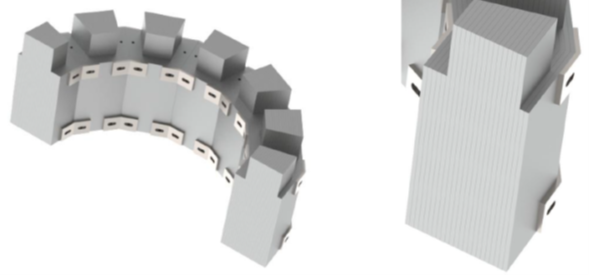
Severe effects of the eddy currents were experienced in the original version of the heat pump. It was assumed that the effect would be worst in the laminated protrusion, and that lamination of the ring was not needed. Lamination is a classical technique for reducing eddy currents and is conventionally done in e.g. transformer cores, where the frequencies can be very high. Laminations must be as thin as possible; in transformer cores they are often of the order of 0.1mm.
The RES4BUILD MCHP will operate at low frequencies, about 0.5 – 2 Hz, much lower than most other equipment. How thin must the laminations be made, and how much space for gluing can be tolerated? Through numerical modelling it was found that that the plates could be as thick as 4mm, without having a significant impact from eddy currents. Also, it was found that an epoxy layer of 2mm in total would only lead to a reduction in the field of less than 1%. On this basis, the ring was built from 13 parts, each consisting of 23 epoxied plates. This has shown that the requirements for lamination are actually fairly modest when the frequency is low.