
Result description
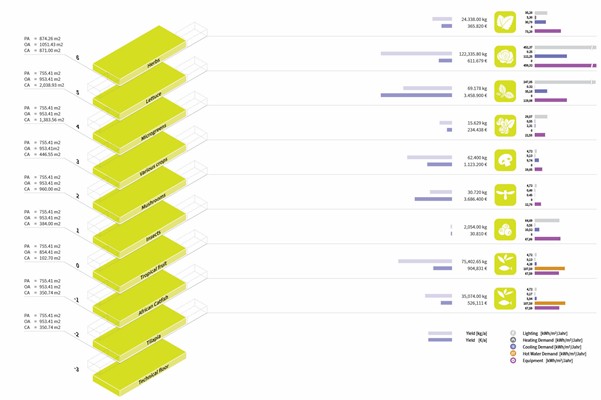
The Food Selector is an advanced knowledge-based module within the euPOLIS Digital Twin environment, developed by the Vertical Farm Institute (VFI) to support planning, optimisation and benchmarking of indoor food production systems. Similar to how building standards define comfort parameters for different typologies, it provides a catalogue of standardised crop-specific benchmarks for indoor farming, including optimal lighting intensity/duration, temperature and humidity ranges, irrigation and nutrient demands, expected yield per square meter, and energy/water inputs per growth cycle. The parameter sets are derived from ongoing desk research and expert interviews with indoor farm operators, ensuring practical relevance. Integrated into simulation workflows, the module enables rapid comparison of crop choices and layouts, supporting energy/yield/cost estimates for comparative studies, feasibility assessments and early investment planning.
Addressing target audiences and expressing needs
- Collaboration
- Fellowship to advance my/our research
Academic partners and research labs to validate and extend the crop benchmark catalogue (lighting, climate, fertigation, yields) and publish reference datasets. Indoor farm operators willing to share anonymised performance data for calibration. Partners to integrate the Food Selector into simulation workflows and benchmarking studies. Funding/support for IP/patent work, data governance, and an online interface with time-limited licensing for broader research use.
- Public or private funding institutions
- Academia/ Universities
R&D, Technology and Innovation aspects
TRL 5-6: knowledge-based module integrated into the Digital Twin, with crop growth/operation parameters derived from desk research and operator interviews. Next steps: expand the catalogue, validate with real performance datasets, formalise data governance and package an online interface with time-limited licensing. We seek academic partners, data contributors, and funding for validation.
Yes. As a modular digital knowledge component, it scales by expanding the crop catalogue and distributing access online. Once parameter sets and governance are standardised, additional users can run comparative studies at low marginal cost. Updates can be released as new datasets/modules without changing the core workflow.
Yes. The Food Selector supports sustainability by enabling evidence-based crop and system choices that improve resource efficiency (energy, water, nutrients) and reduce trial-and-error in indoor farming planning. Value is delivered through a curated, standardised benchmark catalogue grounded in research and practitioner insights, integrated into simulation workflows for fast comparisons. Economic value can be captured through a mixed approach: collaborative development with academia (to grow and validate the dataset) and time-limited online licensing for broader research and professional use. As the catalogue expands and validation increases, the tool becomes more valuable while maintaining quality through documented methods and controlled updates; IP protection (under preparation) can support long-term viability.