

Inertia and Lawrence Livermore National Laboratory (LLNL) have achieved a manufacturing breakthrough for the accelerated production of the frozen layers of fusion fuel needed for Inertia’s utility-scale power plants. This breakthrough reduces the production time for the most sensitive part of the process from days to minutes, in a manner that is compatible with high fusion performance and continuous delivery of the fueled pellets at the rates needed for utility-scale power production. With this achievement, Inertia has crossed off one of the key Top Ten things we set out to demonstrate in phase one of our commercial power plant development. These results make target fueling cheaper and reduce the amount of tritium supply necessary in our plant, lowering material-handling costs, regulatory burden, and dependence on scarce fuel inventories.
The basis of Inertial Fusion Energy (IFE) is to use high-energy lasers to compress and heat a tiny pellet containing fuel so that it ignites and releases massive amounts of energy. The National Ignition Facility (NIF) has repeatedly demonstrated the physics of how this can be done, and Inertia is adopting this design for its power plants, rather than pursuing speculative alternate concepts or unproven target designs or drivers. This pragmatic approach turns fuel formation into a quantifiable throughput problem rather than an unknown physics problem, making Inertia’s challenge how to scale the fuel manufacturing process to mass production.
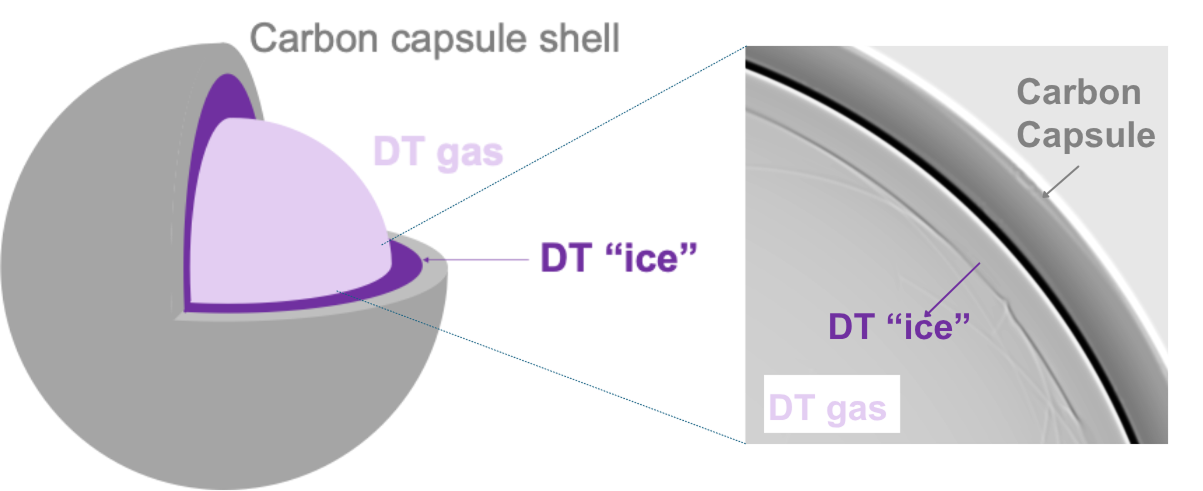
A thin layer of cryogenically frozen Deuterium-Tritium (DT) is a key part of the fuel configuration for this target design, and forming it presents one of the hardest challenges. The DT fuel needs to form an almost perfectly smooth surface on the inside of a small spherical shell (see Figure 1). But the process currently used at the NIF can take up to a week and multiple attempts with manual intervention to form a sufficiently good layer, and can be quite unpredictable. NIF ignition targets use extremely precise fuel layers, as even small imperfections can quench the ignition process. These instabilities rip apart the fuel before it can ignite and burn, analogous to kicking away the logs from a campfire.
Commercial fusion demands faster fueling times
Taking a week and manual intervention to make each fuel layer is not possible in a power plant, which needs to operate like an engine with fuel injected several hundred times per minute. Production times need to be reduced to just a few hours in order to maintain an acceptable fuel inventory.
One proposed solution being studied by many in the community is to inject liquid DT fuel into a thin foam layer that is pre-formed inside the spherical carbon shell. This would be fast, but it unfortunately introduces significant physics uncertainty. The foam premixes unwanted material into the fuel and changes the initial gas density, which reduces compression and performance in unpredictable ways, threatening the ignition process itself. Introducing these additional variables and unpredictability pushes projects further from the proven physics developed by researchers at the NIF.
Inertia’s approach is to stay as close as possible to the proven NIF design. Working with members of the LLNL team that achieved ignition and leveraging access to a unique suite of DT test facilities, the team developed a breakthrough process that produces a pure DT layer well within Inertia’s design tolerances, as verified using the same LLNL codes used to design ignition. The process also reduces formation time from multiple days to just two to three hours. This solution allows fuel to be manufactured at industrial scale using a repeatable fueling process.
“This milestone achievement for commercial target fueling in these very early days for the company would not have been possible without our close collaboration with LLNL, awarded through both our Target Fabrication and Physics Design Strategic Partnership Projects,” said Dr. Annie Kritcher, co-founder and Chief Scientist of Inertia. “Working with the leading specialists in target manufacturing, a new fast fueling method has been developed that enables moving from NIF to commercial fusion energy production. Verification of the impact of this fueling process on Inertia’s design was enabled through our physics design SPP.”
The shift: from perfection to speed
Success in scaling to mass production is measured by the performance of the billionth target, not the first. This new fuel formation process shows that these layers can be grown rapidly at specifications nearing the perfect DT ice that first achieved ignition––at a quality well within the specifications required by Inertia’s design.
“We have developed processes that substantially improve the quality of solid DT layers formed over short time periods,” said Suhas Bhandarakar, a distinguished member of technical staff at LLNL. “In addition, we have developed detailed concepts for adapting these processes to IFE-scale operations.”
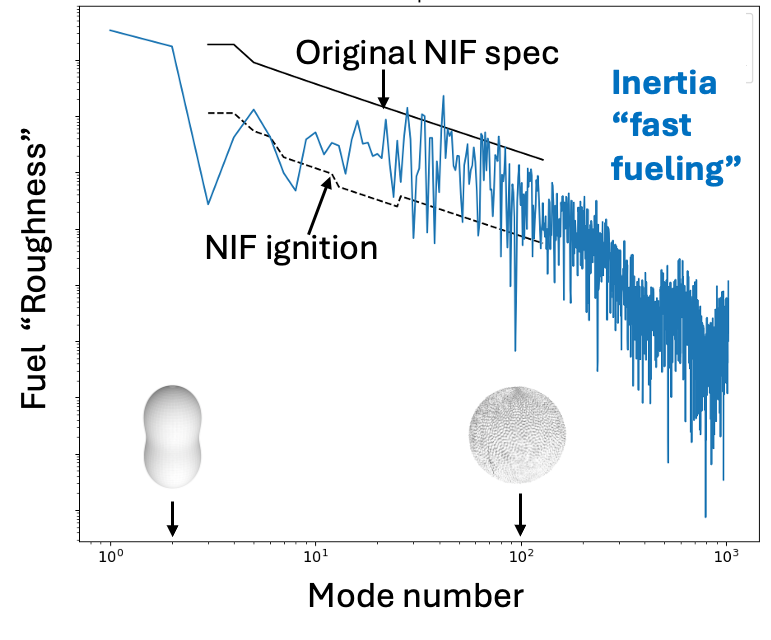
This provides operational flexibility for the power plant. On the one hand, the process can initially be set to operate near demonstrated NIF ignition-level layer quality, providing high assurance of performance with substantial margin, while keeping production times to less than a few hours.
On the other hand, to drive ongoing economic optimization, we can take advantage of the fact that Inertia’s target design, using a much larger laser than NIF (10 MJ rather than 2 MJ), is significantly more robust and substantially less sensitive to imperfections in the DT layer. This allows for the tolerance of some level of imperfection instead of aiming for a flawless crystal structure. This higher tolerance to surface roughness, grooves, and variability in formation can push the manufacturing time down even further, to less than an hour.
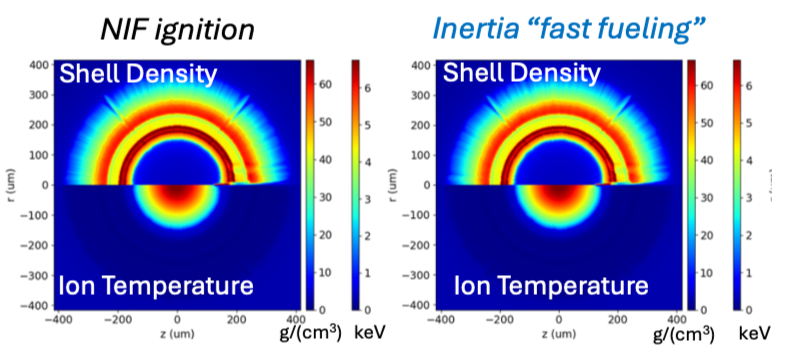
Simulations show that the achieved quality does not reduce the fusion energy produced, nor the state of the compressed shell and heated core (see Figure 3). Even when further artificially dialing up the roughness and size of groove structures to several factors beyond measured, the fusion energy output remains high (within 10% of the maximum). Defects that would strongly degrade or terminate ignition in NIF experiments are tolerated in Inertia’s commercial system. The exact level of tolerance will be tested in an early phase of the power plant commissioning, building from a robust baseline using NIF specification targets.
This represents a shift in philosophy: NIF ignition experiments are optimized to work at the cliff edge of performance, while power plant designs must work reliably and repeatedly. That shift enables tolerance to manufacturing variability and high-throughput production.
Fast fueling has no impact on Inertia’s robust design
“The quality of these rapid ice layers are comparable in many ways to the NIF layers that take much longer to grow. And Inertia’s target design, using a much thicker ice layer than NIF, is more robust to ice defects. The defect dampens proportional to the ice thickness, so a groove that would be problematic on NIF is acceptable at Inertia’s scale,” said Chris Weber, an inertial confinement physicist and Capsule Modeling Team Lead at LLNL.
“This is the most thorough examination of DT ice layering that I am aware of examining the various key practical parameters involved to determine the quality of the layer versus time required to layer demonstrating that it is consistent with IFE needs on both accounts,” adds Abbas Nikroo, deputy director for physics integration at the NIF.
Less is more
Fast layering provides other important benefits for power plant operation and cost reduction. Accelerating target production reduces the required tritium inventory by shortening the time fuel must be held in process. This is an important economic and supply chain consideration in the “start-up” phase of the plant, in the period before tritium self-sufficiency is attained (after which the power plant can make its own tritium). Fast fueling also lessens the regulatory burdens associated with tritium, by keeping the inventory at inherently safe levels.
An early win
“Inertia is moving quickly to develop manufacturing processes that stay as close as possible to ignition-proven physics, scaling what already works rather than introducing new risks,” said Jeff Lawson, co-founder and CEO. “Achieving this milestone is one of several breakthroughs the company will unveil in the coming months, showing that the scientifically proven path to fusion is commercially viable and ready for deployment.”