
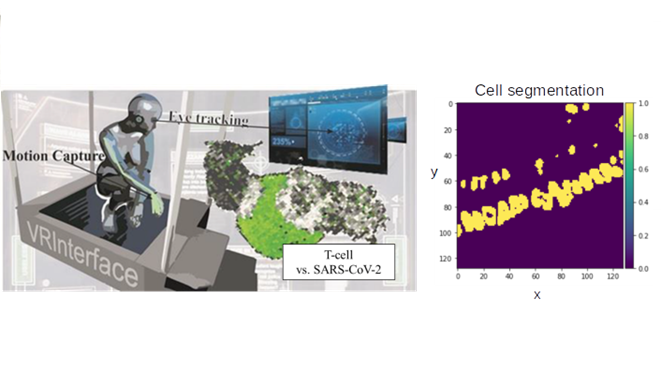
In collaboration with Cambridge University and a British company we have published an article in Nature Methods (check references) where it has been shown that VR is a very useful tool for annotating 3D bioimaging data were the biological nature of the images make the geometries to be irregular and heterogeneous and mostly impossible to segment using traditional methods (i.e. flat screens). Besides the visualisation and manipulation of 3D bioimaging (i.e. super-resolution microscopy) we have demonstrated the possibility to do the rendering, processing and analysis on the server side using containers on the Cloud (Docker, Kubernetes, etc.).
Using these technologies, we will be able to visualize and make annotations of biological samples at the nanoscale (i.e T-cell vs. SARS-CoV-2 in super-resolution or Cryo-EM), and exploit the benefits of the Cloud, establishing the basis for the VR collaborative interface (see figure left). We are at the beginning of a proof-of-concept of an AI biological analysis that can be beneficial for COVID-19 studies, both for its diagnosis and treatment. We have started by analysing cell segmentation in full model specimens (see figure right).