
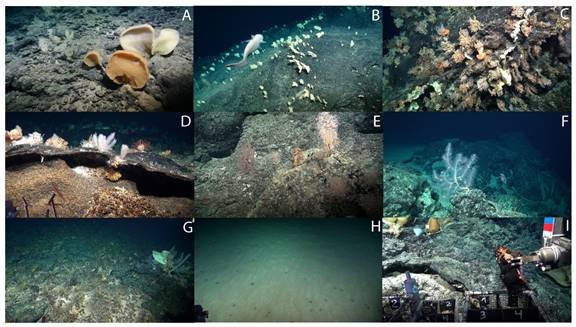
Poliopogon amadou is a large, fan-shaped pheronematid sponge that reaches up to 35 cm in height. Although a habitat forming VME indicator species, its occurrence remains poorly understood.
We have discovered extensive monospecific grounds of P. amadou at the Tropic Seamount, located in an ABNJ in the subtropical North Atlantic Ocean. We have produced an ensemble habitat suitability map for P. amadou distribution using three different modelling techniques; Maximum Entropy (Maxent), General Additive Models (GAMs), and Random Forest (RF), for the purpose of management applications.
These models, and the maps produced, can fill knowledge gaps and provide some guidance, rather than none, on the distribution of VME indicator species and inform on-going high seas management efforts such as maritime spatial planning, environmental impact assessments and the conservation of biogeographically unique provinces. They could also contribute to UN negotiations of a new treaty to protect biodiversity beyond national jurisdiction (BBNJ).