
Result description
The focus on expanding the sector coupling and binding the electricity system and end-user sectors like the transport and industry bring attention to environmental trade-offs. Otherwise, unintended environmental impacts could potentially impede the transformation process. Given that, work package 6 aimed to identify and discuss unintended environmental burdens that should require government attention. For that, the approach of coupling Life Cycle Assessment with the bottom-up electricity model (ELTRAMOD) was presented to analyze the REFLEX scenarios. Results showed that the large impact on metal depletion bring the challenge that transformation processes need attention on the global limits related to finite resources comparable to fossil-fuels.
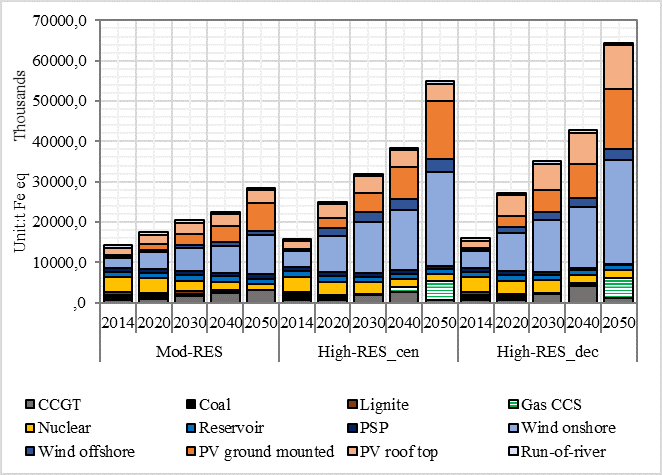
The figure shows that regardless of the envisaged scenario or temporal case, metal depletion increases due to increased solar and wind energy generation. The highest share of wind and solar electricity generation in High-RES decentral (to achieve, for instance, the demand for hydrogen production in industry in 2050) increases the metal depletion impact to over 290% compared to the year 2014. Meanwhile in Mod-Res and High-Res central, the growth are 75% and 235% for the same period respectively. The results are created upon the model coupling of LCA and ELTRAMOD to assess the REFLEX scenarios. The outcomes are highly interconnected to the LCA modeling and the assumptions made. The find suggests that a more tightly integrated EU, not in political terms but rather concerning technology and supply markets, would help to address the challenges related to metal depletion.
Addressing target audiences and expressing needs
- To raise awareness and possibly influence policy
- Grants and Subsidies
- Collaboration
Collaboration and calls for projects which could be adequate to our scope on “system analysis and quantitative risk engineering approach for strategic raw materials and technologies.” There is a global preference for technology innovation that must be replicable at an economical cost to satisfy energy targets. Resources are crucial, and currently, EU28 imports metals, but often the technology as a whole. Any smooth transition requires a strategic and sustainable supply chain. Our approach is to disclose potential measures for technology developers and policy-makers.
- Public or private funding institutions
- EU and Member State Policy-makers
- Research and Technology Organisations
Result submitted to Horizon Results Platform by KARLSRUHER INSTITUT FUER TECHNOLOGIE