Result description
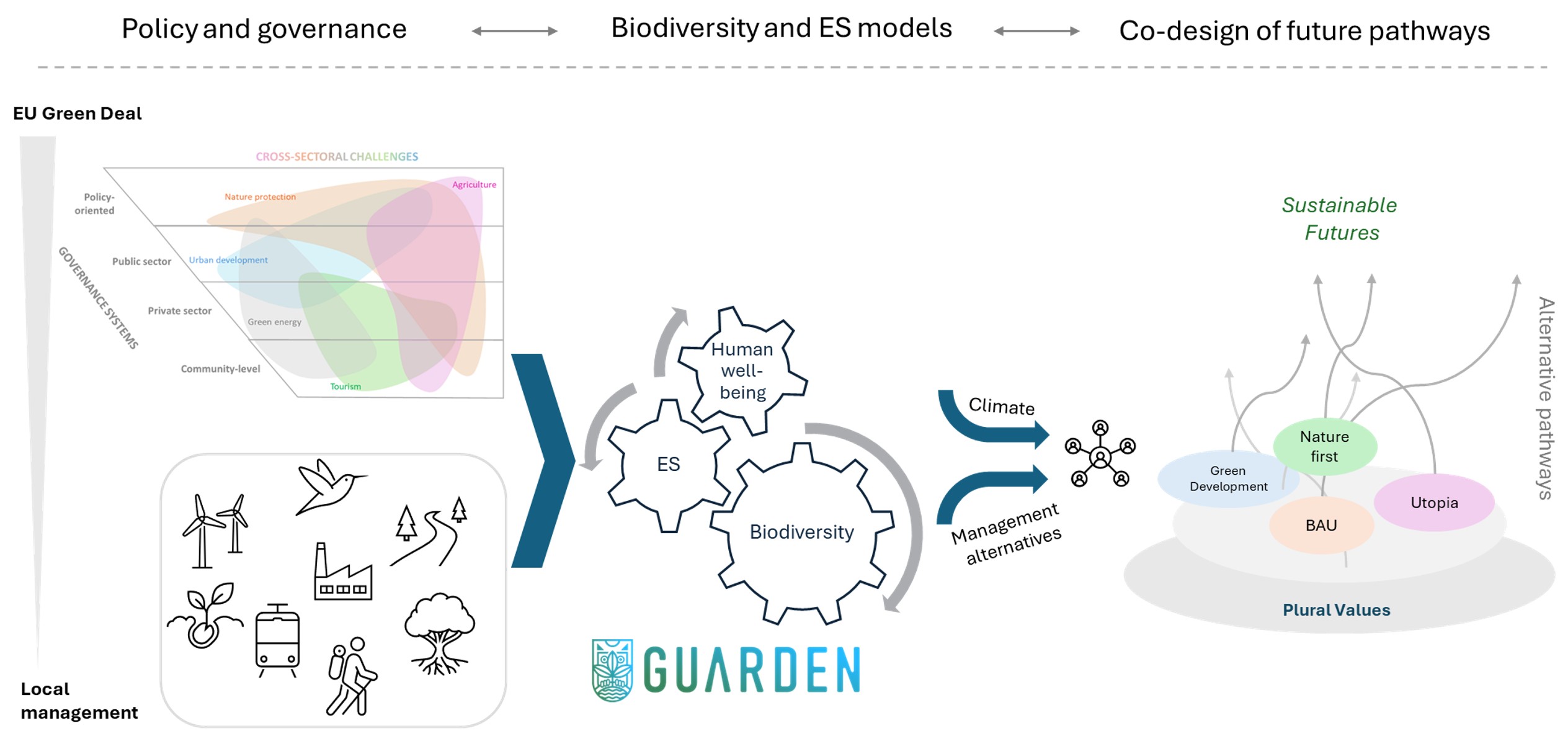
Main features: Assess and visualise the current and potential future states of biodiversity and ecosystem services.
Objectives: Integrate diverse data sources of biodiversity, habitats, natural and cultural heritage, agricultural production, infrastructure development, and green energy to develop spatially explicit models that depict ES supply, as well as their trade-offs, and synergies.
Advantages: By incorporating stakeholder engagement, the framework ensures that the ecosystem services assessments and their outputs (maps) align with real-world priorities, enhancing their applicability in decision-making processes. Why is it important: Support real-life decisions of local stakeholders and produce outputs that are relevant to their needs and priorities under different scenarios.
Why is it important: Support real-life decisions of local stakeholders and produce outputs that are relevant to their needs and priorities under different scenarios.
Addressing target audiences and expressing needs
- To raise awareness and possibly influence policy
Results target the community of local decision-makers, as they are the ones who could make use of the methods developed within GUARDEN to inform future planning activities in the different countries. They intention is that this information is taken up also at the EU level.
- EU and Member State Policy-makers
- Research and Technology Organisations
- Academia/ Universities
R&D, Technology and Innovation aspects
- Present findings at relevant international or regional conferences
- Finalize and circulate policy brief(s) through GUARDEN and other networks
- Promote results via institutional communication channels and academic social media
The approach developed is scalable based on the different policy needs. For that however, additional data collection should be made.
Result submitted to Horizon Results Platform by CHAROKOPEIO PANEPISTIMIO