
Result description
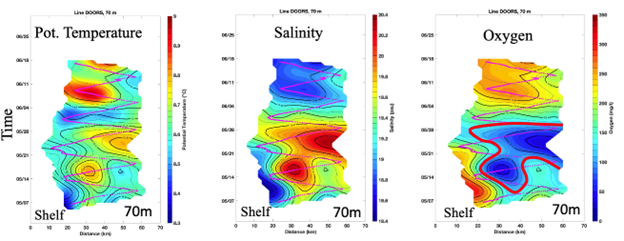
Glider observations revealed an intrahaline cyclonic eddy uplifting anoxic water into the euphotic layer (~70 m), disrupting the Black Sea’s stratification and posing a serious threat to oxygen-dependent marine life. The high-resolution data captured the fine-scale vertical structure and the pathways of anoxic waters, offering rare insight into transient, subsurface dynamics. This event highlights not only a previously underappreciated mechanism of cross-pycnocline exchange but also the significant role of gliders in resolving such processes in the Black Sea, a strongly stratified system. In addition, we observed that the temperature increased up to 3°C in the upper layer in less than two weeks, highlighting the rapid changes that take place in the upper layer during the spring-to-summer transition period. Meanwhile, the presence of potential Synechococcus and subsurface chlorophyll maxima point out the complex phytoplankton distribution.
A total of 43 days glider deployment covering a distance of more that 440 km, repeating 10 perpendicular sections in the shelf in parallel to Danube cone. A 3D product with a resolution of 2 m on vertical and 5 km on the horizontal for every day of survey. We interpolated to potential density isopycnals
Home messages from our Glider work in the Black Sea:
- Identify a Coherent Cyclonic Eddy in the halocline and understanding water masses distribution
- We capture the upwelling of anoxic waters in the Upper Layer (∽70 m) which can lead to shifts in marine productivity and nutrient availability.
- We observed Significant temperature changes (>3°C) in less two weeks during Spring-Summer Transition:
- The glider observations indicate complex phytoplankton distributions.
- The glider observations reveal high suspended particulate matter (bbp 700 nm), possibly originating from the Danube cone which indicate changes in water clarity and sediment load.
Addressing target audiences and expressing needs
- Collaboration
The results are interesting for researchers, environmental manages and policy makers that are working at the intersection of ocean monitoring technology and ecosystem health who rely on high‐resolution, in situ observations to understand the physical and biogeochemical processes and their role in the fragile Black Sea ecosystem.
- EU and Member State Policy-makers
- Research and Technology Organisations
- Academia/ Universities
R&D, Technology and Innovation aspects
First deployment in the Black Sea of a glider. Next steps include:
- development of the capacities of riperian institutes to use these technologies for investigation of physical and chemical conditions of the Black Sea
- design and initiate monitoring programs around the Black Sea for a comprehensive image of the marine environment state using glider fleets
Result submitted to Horizon Results Platform by INSTITUTUL NATIONAL DE CERCETARE-DEZVOLTARE PENTRU GEOLOGIE SI GEOECOLOGIE MARINA-GEOECOMAR