

This press release was issued by Dresden University of Technology and provides a summary of a scientific article published in the journal “Nature Synthesis” under doi.org/10.1038/s44160-025-00970-w
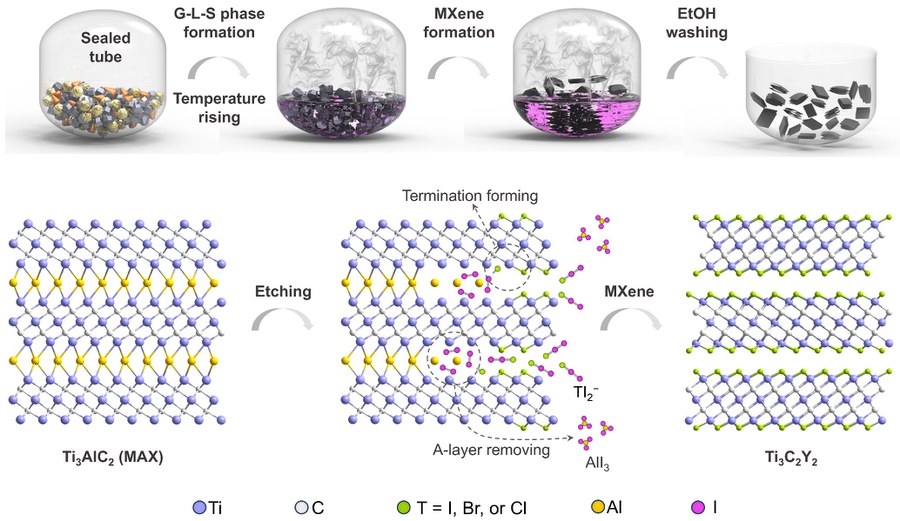
Triphasic Synthesis of MXenes with Uniform and Controlled Halogen Terminations
A recent article by researchers from the Max Planck Institute of Microstructure Physics and TU Dresden, published in Nature Synthesis, presents a “gas-liquid-solid” (GLS) triphasic etching strategy that employs iodine vapor, halide molten salts, and MAX phases to produce MXenes with pure and precisely tunable halogen terminations (Cl, Br, I, or their combinations). In this process, halide molten salts dissolve iodine via interhalogen anion formation while efficiently transporting etching by-products. The resulting MXenes retain excellent structural integrity, yielding uniformly ordered surfaces. As a representative example, Ti3C2Cl2 shows a 160-fold enhancement in macroscopic conductivity and a 13-fold enhancement in terahertz conductivity relative to conventional Cl/O-terminated Ti3C2, attributed to minimized electron trapping and scattering. Beyond single-halogen terminations, the GLS approach enables dual- and triple-halogen termination control, providing a general platform for tailoring MXene surface chemistry toward advanced (opto)electronic applications.
The paper entitled “Triphasic Synthesis of MXenes with Uniform and Controlled Halogen Terminations” by Dongqi Li, Wenhao Zheng, Mahdi Ghorbani-Asl, Juliane Scheiter, Kamil Sobczak, Silvan Kretschmer, Josef Polčák, Pranjali Hirasing Jadhao, Paweł P. Michałowski, Ruoling Yu, Jiaxu Zhang, Jinxin Liu, Jingwei Du, Quanquan Guo, Ehrenfried Zschech, Tomáš Šikola, Mischa Bonn, Nicolás Pérez, Kornelius Nielsch, Arkady V. Krasheninnikov, Hai I. Wang, Minghao Yu, Xinliang Feng can be found at: https://doi.org/10.1038/s44160-025-00970-w