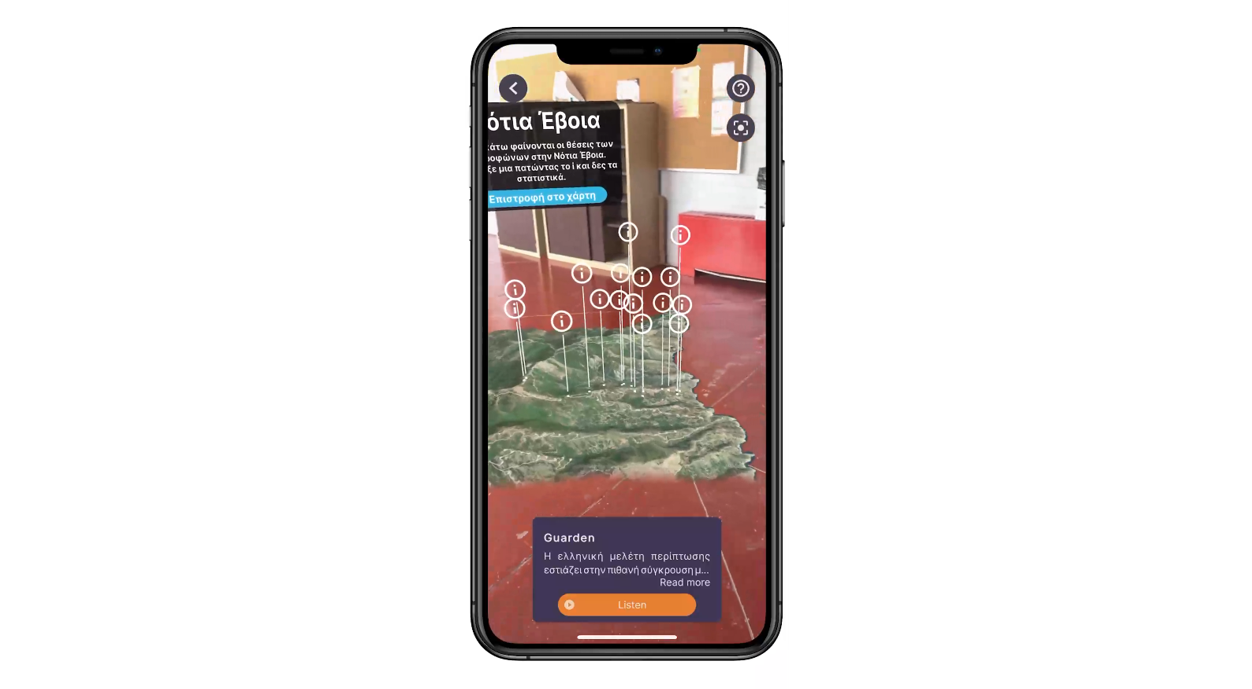
Result description
Experience biodiversity through augmented reality, explore ecosystems with interactive 3D models, access detailed species information and audio samples, and contribute to ongoing scientific research.
Main features: AR visualisation of 3D simulation models tailored to stakeholder groups; interactive terrain annotation and guidance tools.
Objectives: Enhance stakeholder engagement and understanding of biodiversity restoration through immersive and manipulable AR content.
Advantages: Customised AR experiences per user type; supports both guided and free exploration with contextual annotations.
What is new: Combines user-driven AR interaction with simulation feedback and contextual geospatial features in one mobile app.
Why is it important: Facilitates deeper engagement and more informed decision-making in biodiversity actions among diverse stakeholder groups.
Addressing target audiences and expressing needs
- To raise awareness and possibly influence policy
Designed for environmental stakeholders, educators, and citizen scientists seeking to engage with and better understand local flora and fauna.
- EU and Member State Policy-makers
- Research and Technology Organisations
- Academia/ Universities
R&D, Technology and Innovation aspects
- Iterate on user feedback from pilot sites, test AR usability across devices, and co-design features with stakeholders.
- Develop a modular AR platform for environmental and educational use; explore licensing to NGOs, municipalities, and research institutes.
- Agile development, stakeholder workshops, Unity3D for AR, UX testing, and integration with data pipelines.
The tool is built on a modular and data-driven architecture that allows easy adaptation to new geographic areas and environmental themes. Its AR framework can integrate any open or locally sourced biodiversity datasets, while the 3D visualization and citizen science modules can be customized for different ecosystems, languages, and user groups. This makes the tool readily replicable across regions, institutions, and educational programs, requiring only localized content and data inputs.
The tool is designed for long-term sustainability through its open, modular architecture and alignment with ongoing environmental education and citizen science initiatives. By integrating open data sources, community-generated content, and partnerships with educational and environmental institutions, it ensures continuous content renewal and relevance. Although its business model is still under development, sustainability is supported through potential licensing for educational use, collaboration with NGOs and municipalities, and integration into broader digital environmental platforms.
Result submitted to Horizon Results Platform by EREVNITIKO PANEPISTIMIAKO INSTITOUTO SYSTIMATON EPIKOINONION KAI YPOLOGISTON