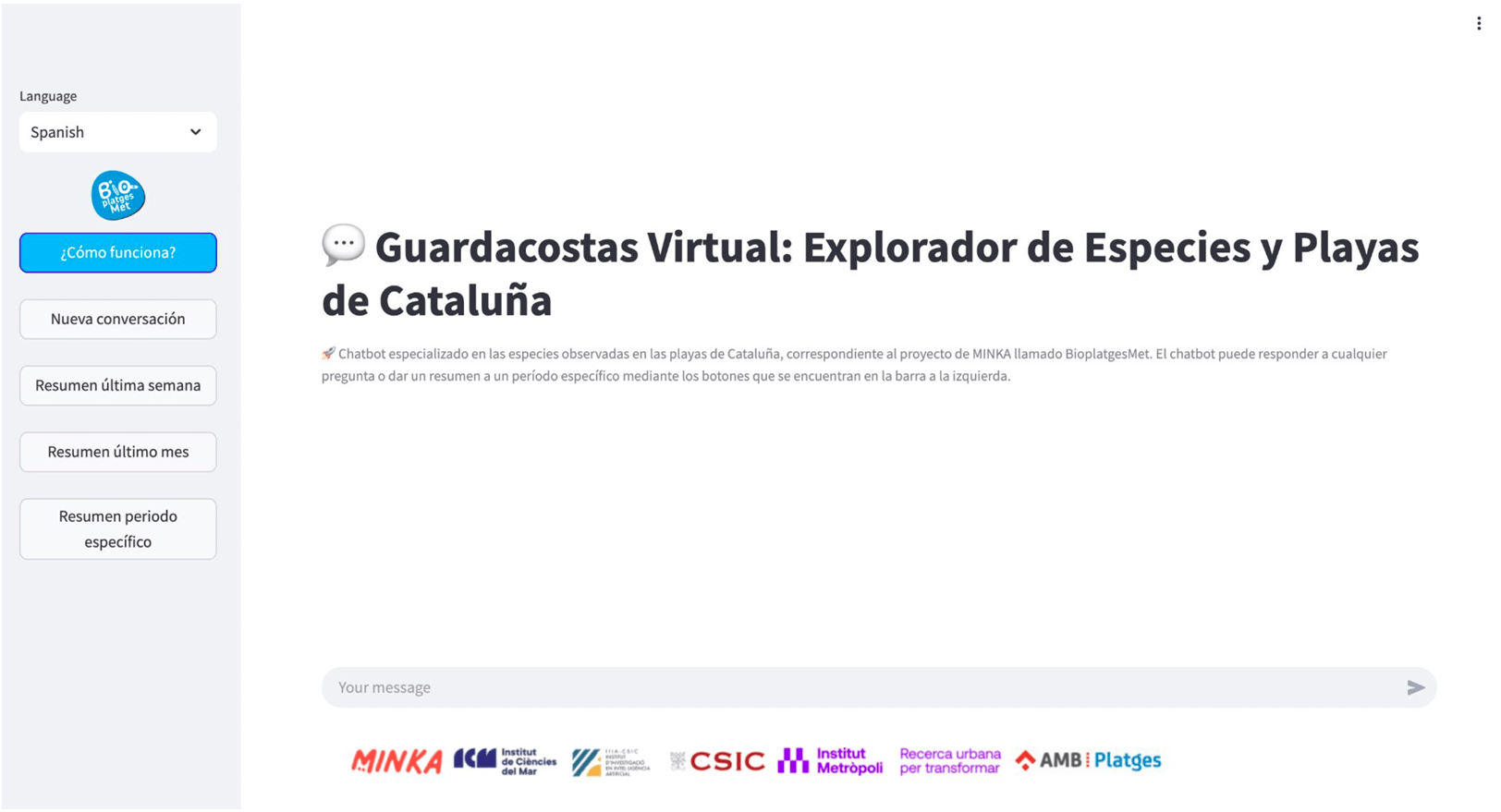
Result description
Discover and explore the rich biodiversity of Catalonia’s coast through natural conversation. Our chatbot is an AI-powered virtual assistant designed to make environmental and scientific data accessible to everyone — from researchers to citizen scientists.
Ask questions about species, ecosystems, or conservation efforts, and get answers backed by real project data, scientific literature, and up-to-date visualizations. The chatbot integrates advanced AI technologies (GPT-4o-mini, LangGraph, and RAG) to search documents, analyze datasets, and even generate plots — all through an intuitive, multilingual web interface (Catalan, Spanish, English).
Whether you’re monitoring beach ecosystems, analyzing trends, or simply curious about local biodiversity, our chatbot turns complex data into insight — one conversation at a time.
👉 Try it out and see how AI can help protect our natural world.
Main features: Guardacostas Virtual is an AI-based chatbot that interacts with citizens and users of beaches in the Barcelona metropolitan area. It provides responses to frequently asked questions and connects users with relevant information about beach management and biodiversity.
Objectives: The chatbot aims to strengthen communication between citizens and local authorities, support the BioPlatgesMet citizen science initiative, and contribute to research on how artificial intelligence can support environmental management.
Advantages: The chatbot operates without collecting personal data, requiring registration, or using tracking systems. It provides reliable and easy access to information for citizens, while supporting public research and fostering collaboration between institutions and the public.
What is new: This prototype is specifically built for a real-world case study, with expert-validated content and an iterative approach to improving its responses.
Why is it important: It offers a controlled and research-oriented example of how AI can support environmental communication and citizen engagement in urban coastal areas.
Addressing target audiences and expressing needs
- To raise awareness and possibly influence policy
Citizens and policy makers who are willing to engage in a conversation to evaluate the biodiversity of the Catalonia coastal system.
- EU and Member State Policy-makers
- Research and Technology Organisations
- Academia/ Universities
R&D, Technology and Innovation aspects
This prototype is part of the research developed by IIIA-CSIC and will be integrated into future developments, including as a core element of the developer’s doctoral research. As such, the refinement and advancement of the model will continue through ongoing research activities. While there are no specific milestones currently defined, it serves as a foundation for future iterations.
The business model of the project is highly scalable, as the chatbot framework can be adapted and replicated across multiple environmental management contexts with minimal additional cost. Once developed, deploying the system for new regions or projects—such as other coastal monitoring programs, protected areas, or urban biodiversity initiatives—mainly requires connecting to local datasets and adjusting the interface language and branding. This scalability enables partnerships with municipalities, research institutions, and citizen science platforms, offering a sustainable service model based on customization, data integration, and maintenance rather than redevelopment from scratch.
The project is highly replicable thanks to its open-source foundation, modular architecture, and standardized technology stack (Docker, LangGraph, LangChain, Milvus, Streamlit). Its components can be easily redeployed in other geographic or thematic contexts — for example, adapting from coastal biodiversity monitoring to forest, wetland, or urban ecosystems — simply by integrating new datasets and retraining or reconfiguring the retrieval layer. Moreover, the multilingual and configurable interface facilitates adoption by different institutions or citizen science projects, making it a practical blueprint for replicating AI-driven environmental data assistants in diverse regions or research domains.
From a technical perspective, the system is designed for low maintenance and efficient operation: it uses lightweight containers, cloud-based AI models (like GPT-4o-mini), and automated data updates via cron jobs. This minimizes infrastructure costs while ensuring continuous access to current biodiversity information.
From a business and institutional perspective, sustainability comes from its adaptability and collaborative value. The chatbot can serve multiple stakeholders — municipalities, research centers, and citizen science networks — under a shared digital infrastructure. This enables cost sharing, continuous data enrichment, and policy integration, turning it into a self-reinforcing ecosystem where environmental insight, public engagement, and decision support grow together over time.
- Spain
Result submitted to Horizon Results Platform by AGENCIA ESTATAL CONSEJO SUPERIOR DE INVESTIGACIONES CIENTIFICAS