Result description
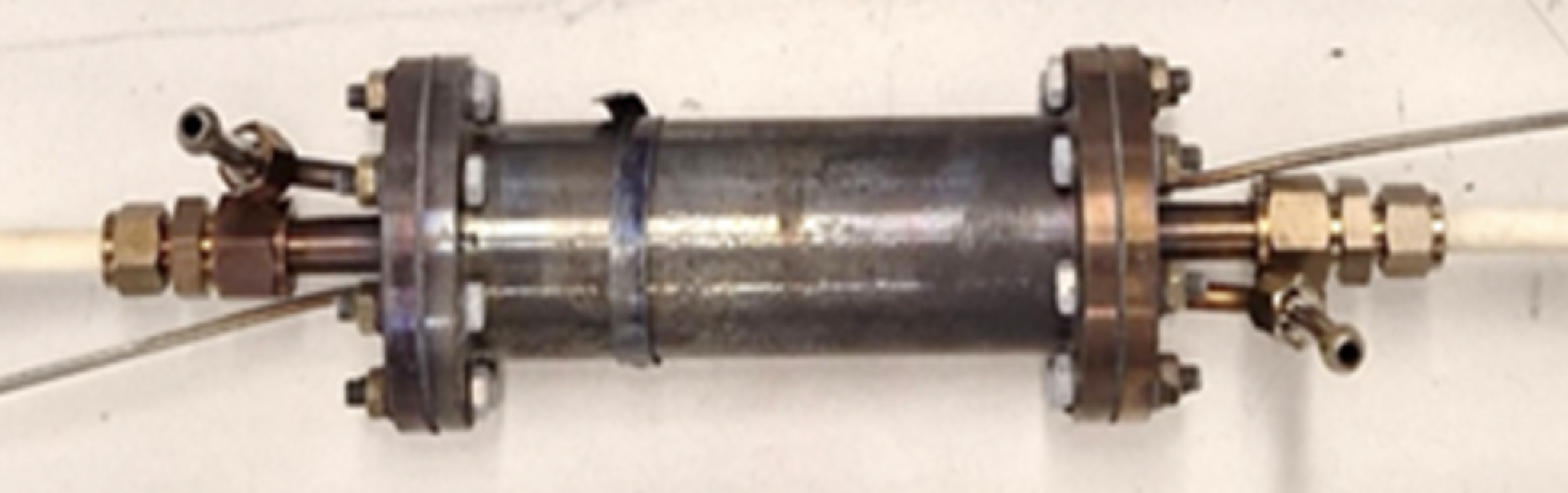
Our result is an electrified ammonia cracker presenting unique performances in terms of space efficiency (kg of hydrogen produced on space unit), thermal efficiency, electrical consumption (kWh per kg of produced hydrogen), compactness and dynamism (transient step between the input of ammonia and the output of hydrogen). All these results are achieved thanks to the unique structure of the reactor, that provides superior heat distribution and catalyst efficiency. This solution perfectly suits on-board H2 generation, where flexibility and efficiency are essential to reach a full integrability. The electrification highly increase the efficiency but also limits the scale of this solution to small to medium applications.
The electrified ammonia cracker packed with Ru-based catalyst, achieved cracking consumption (electrical kWh per kg of produced hydrogen) performance under 15, which is better than commercially available modules. A close to total conversion under 500 °C at a space velocity of 10000 Ncc/h/g catalyst. And a transient step less < 10 min, which means that, given the homogeneous heat deployment and its efficiency, the reactor allows fast change of loads, like the ones needed for on-board uses.
Addressing target audiences and expressing needs
- Grants and Subsidies
- Collaboration
- Business Angels
We are looking for cooperation with academic partners expert in alternative fuels and off-road vehicles. Besides, we are willing to engage the automotive industry for further exploitation opportunities.
- Public or private funding institutions
- Research and Technology Organisations
- Private Investors
R&D, Technology and Innovation aspects
We reached TRL3 by validating our electrified ammonia cracker, through analytical and experimental proof of concept. Lab-scale already outperforms commercial solutions in efficiency, compactness, and response. A preliminary LCA confirms compliance and sustainability. Next step: engine integration to enable on-board demo and advance towards TRL6.
The scalability of our business is rooted in the modular and flexible design of the INCANT ammonia cracker, which adapts seamlessly to small and medium applications, from off-road machinery to commercial vessels and distributed H₂ hubs. Manufacturing is supported by industrial-grade suppliers and abundant ceramic materials, with catalysts fully recyclable, securing resilience and cost efficiency. Component costs remain low, while recovery of catalyst reduces OPEX and supports sustainable economics. Beyond outperforming competing crackers, our solution opens markets otherwise unaddressable, enabling cheaper and more sustainable zero-emission systems compared to batteries and fuel cells. Organizationally, we are establishing a joint company structure uniting technical and business expertise, with a 3-year plan to reach TRL6 demonstrators laying robust grounds for market entry and growth.
The reactor is designed for straightforward replicability, relying only on industrially available manufacturing procedures for assembly and maintenance. All key components are already commercially available, with alternative suppliers identified to ensure resilience. This guarantees that production capacity can be scaled up efficiently in response to market demand growth, without compromising quality or reliability.
Our solution is inherently sustainable, as it requires no Critical Raw Materials and is built entirely from standard, widely available European components. This avoids supply chain risks while keeping costs under control. The business model is centered on reactor design and sales, ensuring revenues scale directly with market demand. By eliminating the use of precious materials, we reduce costs, accelerate adoption, and build long-term customer relationships based on affordability and reliability.
- Europe
- Global
Result submitted to Horizon Results Platform by DAY ONE SOCIETA A RESPONSABILITA LIMITATA