Result description
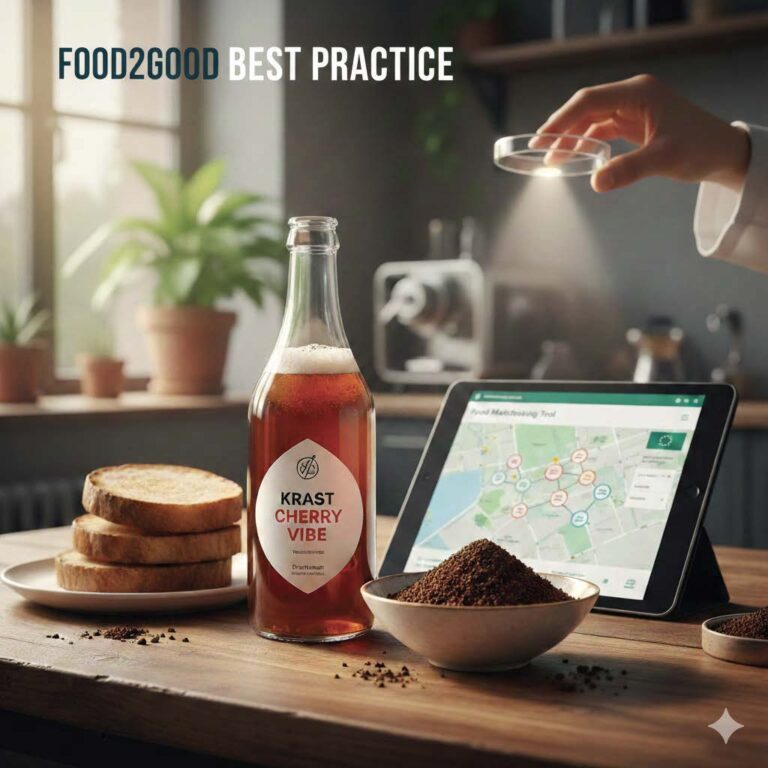
The Food2Good project successfully concluded in October 2025, delivering a validated system for valorizing surplus bread and spent coffee grounds into market-ready solutions. A primary result is the industrial-scale production of the Krast Cherry Vibe, which transitioned from initial test runs to full 2,000-liter batches. This process confirmed the stability of technical parameters such as pH levels, sugar content (Bx), and probiotic counts across a portfolio of 12 functional flavor recipes.
Central to the project’s operations is the Copilot tool, a digital dashboard and marketplace that connects food waste generators with upcycling partners. This system provides real-time traceability and supply mapping, which is essential for B2B partners focused on ESG reporting. Safety was rigorously verified through analytical studies, confirming 100% microbiological purity and the absence of pathogens or heavy metals. Furthermore, the project demonstrated multisectoral versatility, showing that valorized coffee materials can be diverted to other industries, such as the production of durable consumer goods like flowerpots.
Addressing target audiences and expressing needs
- Expanding to more markets /finding new customers
The Food2Good project offers a validated blueprint for the circular economy, turning surplus bread and coffee grounds into a scalable success. Key best practices include:
- Scalability: moving from 1,000L to 2,000L batches ensures technical stability at an industrial scale.
- Digital tools: using a Matchmaking Tool (Copilot) provides real-time traceability and supply mapping.
- Synergy: success requires collaboration across IT, biotech, and academia.
- Regulation: aligning with food safety laws and waste classification is critical for replication.
- Public or private funding institutions
- EU and Member State Policy-makers
- Other Actors who can help us fulfil our market potential
R&D, Technology and Innovation aspects
The project is 100% complete and market-ready. It confirmed industrial scalability by transitioning from 1,000L test runs to 2,000L batches while maintaining technical stability. The next step is for international stakeholders to use the validated checklist to scale the model into new global markets
The key Best Practice developed in the project is the “scalability-first” approach, which mandates designing upcycling processes with industrial volumes in mind right from the laboratory stage. This model was validated through a progressive scaling path: from 1,000L test batches to full-scale 2,000L production, confirming the stability of critical parameters such as pH and Bx in real-world conditions. A recommended operational practice is to leverage existing infrastructure (e.g., breweries) instead of building new facilities, which drastically lowers the barrier to entry and the carbon footprint. Scaling is further supported by a digital matchmaking system, established as a best practice to ensure the synchronization of raw material supply with production schedules, enabling the model’s replication in any market with high bread and coffee consumption.
Replicability is established as a core Best Practice by providing a validated Global Replication Checklist and an industrial-scale framework that allows international stakeholders to adapt the model to any region with high bread and coffee consumption by aligning local regulations with the project’s proven technical and digital standards.
The long-term sustainability of the Food2Good model is built on three resilient pillars defined as Best Practices. Economic resilience is achieved through an “asset-light” strategy that utilizes existing fermentation infrastructure, such as breweries, to minimize CAPEX and lower financial barriers for Krast beverage production. Operational scalability is ensured by the Copilot tool, which maintains supply chain stability by automating the matchmaking of surplus bread and coffee grounds with production needs while providing necessary data for ESG compliance. Finally, environmental and market flexibility is maintained by aligning with EU 2030 food waste targets and offering multisectoral versatility, allowing valorized materials to be diverted into either food products or durable goods like flowerpots to remain robust against shifting regulations.
- Europe