
Result description
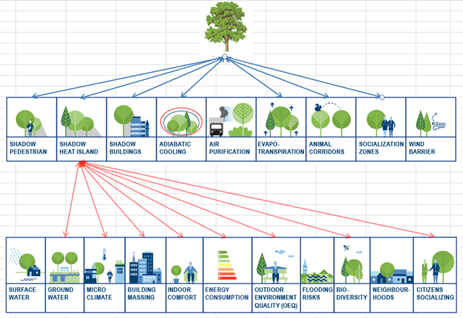
The Functional Greenery Urban Planning Methodology is a practical approach for designing city greenery strategies that maximise multifunctional value. Instead of treating parks, gardens and green corridors as isolated elements, it maps existing green assets alongside local requirements and potentials to identify where greenery can deliver combined environmental, social and economic outcomes. The methodology supports the integration of green corridors, community/urban gardens and recreational landscapes into the urban fabric, enabling benefits such as improved air quality, cooler streets, stronger community interaction and refurbishment of ecosystem services. Developed through participatory workshops and aligned with the euPOLIS Goal-Driven Planning Matrix (GDPM), it provides mapping tools and strategic guidance that can be used in city planning processes, private development projects and public tenders. It is field-ready (TRL 8) and best exploited through consultancy services, education and planning procurement.
Addressing target audiences and expressing needs
- Grants and Subsidies
- Business partners – SMEs, Entrepreneurs, Large Corporations
- Business plan development
Municipalities and planning institutions to pilot the methodology in masterplans and greenery strategies, share baseline GIS/land-use data, and validate multi-benefit targets. Private developers and planning consultancies to apply it in development sites and demonstrate activated synergies (air quality, cooling, gardening, social space). Partners to co-develop local toolkits, training modules and tender-ready templates, and to document case studies for replication.
- Public or private funding institutions
- Other Actors who can help us fulfil our market potential
- Private Investors
R&D, Technology and Innovation aspects
Field-ready methodology aligned with GDPM and proven through participatory planning practice. Next steps: scaling via tender-ready templates,GIS-based workflows, and training/curriculum packages, supported by case studies from city and private development applications. We seek municipalities and developers for replication projects and (where needed) funding for toolkit packaging and dissemination.
Yes. It is a repeatable methodology that can be applied to different cities and development sites using standard planning inputs (GIS, land use, needs mapping). Scalability is supported through reusable templates, tender-ready deliverables, and training/curriculum integration. Consultancy delivery enables quality control while replication grows across multiple projects.
Yes. The methodology creates sustainable value by enabling green infrastructure that improves environmental quality (air, cooling, ecosystem services) and social well-being while unlocking economic opportunities such as productive urban gardening and more efficient use of public space. Value is delivered through site and city-scale mapping, synergy identification and strategic guidance that can be embedded in planning workflows and procurement. Economic value is captured through consultancy services for detailed site analysis and planning support (for municipalities and private developments), complemented by uptake through academic curricula and city planning tenders. As templates and workflows are standardised, delivery becomes more efficient while maintaining quality, supporting long-term viability and broader societal benefit beyond the provider.