
Result description
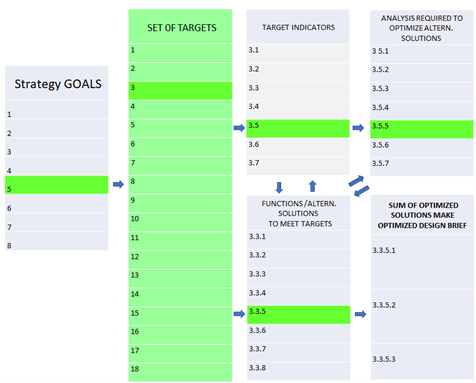
The Goal-Driven Planning Matrix (GDPM) is a structured framework for integrating Nature-Based Solutions (NBS) into urban planning by linking strategic goals (e.g., improved public health and well-being, enhanced social cohesion, environmental resilience) to indicators, targets and recommended planning measures. Presented as a practical matrix, it supports planners, policymakers and stakeholders in moving from high-level objectives to site-level interventions, while capturing synergies where a single resource delivers multiple benefits (e.g., shading that reduces heat stress and energy demand). GDPM complements tools such as the euPOLIS Visualization Platform and the NBS Preliminary Selection Tool, and is designed to be tailored and co-developed with local expertise rather than used as a closed “off-the-shelf” solution. It is publicly available through euPOLIS deliverables and can be scaled via training, workshops and planning advisory services.
Addressing target audiences and expressing needs
- Business partners – SMEs, Entrepreneurs, Large Corporations
- Investor readiness training
- Expanding to more markets /finding new customers
Municipalities and planning authorities to pilot GDPM in real projects and embed it in planning/approval processes. Urban developers to apply GDPM in large developments and validate goal–indicator–measure links. Partners (city networks, consultancies, universities) to co-develop local adaptations, deliver training/workshops and document replication. Funding/support to scale roll-out, produce toolkits and build implementation case studies.
- Public or private funding institutions
- Other Actors who can help us fulfil our market potential
- Private Investors
R&D, Technology and Innovation aspects
TRL 8: GDPM is a mature, field-ready planning methodology published as a public document and applicable in real planning and approval workflows. Next steps focus on scaling uptake through city trainings, local tailoring, and implementation case studies. We seek public/private funding and partner support for roll-out, toolkit packaging and replication across cities and large developments.
Yes. GDPM is scalable because it is a repeatable methodology that can be tailored to different city contexts while keeping a consistent goal→indicator→measure logic. Scaling is supported through standard training modules, policy toolkits and consultancy delivery, and it complements digital tools (e.g., visualization and screening tools) to embed it in broader planning workflows.
Yes, GDPM and its exploitation model can be sustainable long-term. Value proposition: it helps cities and developers plan NBS that deliver measurable co-benefits (public health & well-being, social cohesion, climate resilience) and avoid ad-hoc interventions that miss synergies. Value creation/delivery: the methodology is applied through planning services, city strategies/masterplans, and tailored workshops/training co-developed with local stakeholders, building capacity and embedding the approach into routine planning and approvals. Value capture: revenues come from repeatable consulting/service contracts (municipal planning support, strategic mapping, large private developments) and scalable training/online course bundles and policy toolkits. By enabling interventions that maintain/regenerate natural and social capital while improving long-term efficiency and risk reduction, it supports sustainability beyond the implementing organisation.