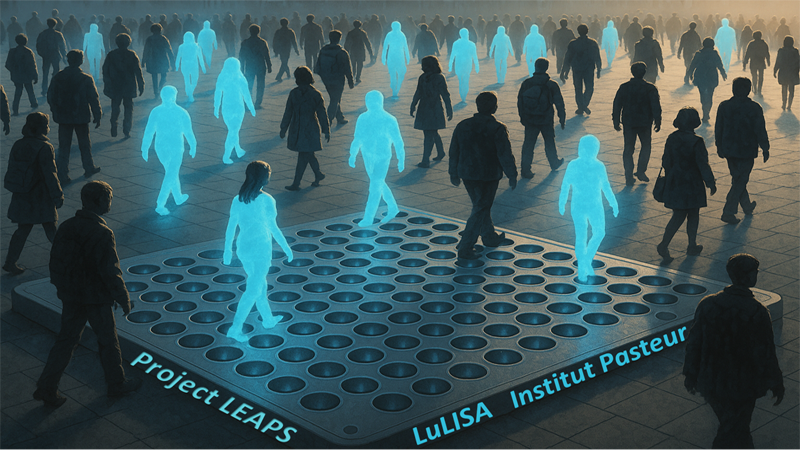
The LEAPS project (LEarning and Adaptive European Pandemic Preparedness System) aims to strengthen EU health security by creating an adaptive network for genomic surveillance, immune response monitoring, and rapid countermeasure development.
Within this framework, Work Package 2 (WP2), led by Institut Pasteur, develops LuLISA, a next-generation immunoassay platform combining high sensitivity, speed, and scalability. LuLISA uses VHH single-domain antibodies fused to a bright luciferase reporter, enabling ultra-sensitive detection (femtomolar range) and high-throughput processing (2,300 tests/hour).
LuLISA has been applied to SARS-CoV-2, influenza and RSV, with planned extension to emerging climate-driven viruses such as West Nile virus. It also supports point-of-care testing via rapid formats like LuLiFlash.
To demonstrate real-world value, WP2 conducted a large-scale immune surveillance study in Ile-de-France, analyzing 3,000 plasma samples collected after the 2024 Paris Olympics.
To ensure sustainability, Biocellis, a start-up co-founded by Institut Pasteur, will industrialize and deploy LuLISA-based kits, reinforcing Europe’s diagnostic autonomy and pandemic preparedness.