
Result description
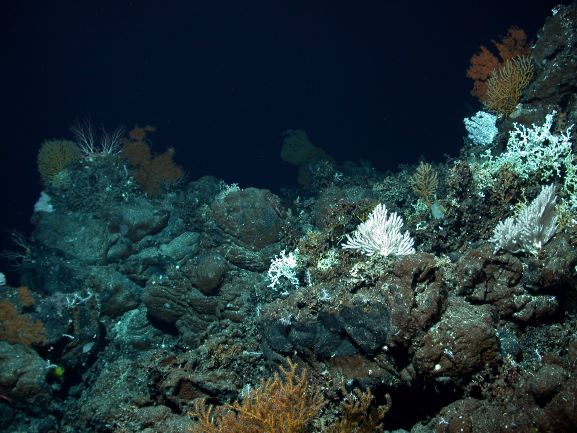
As “ecosystem engineers”, cold-water corals (CWC) build reefs that are unique biodiversity hotspots in the deep sea. They are considered as vulnerable marine ecosystems that provide important ecosystem services. The future fate of CWCs under ongoing global change is difficult to assess as we don’t have enough data on what could negatively impact them. Therefore, we developed a new approach, utilising geological data documenting past CWC ecosystem shifts, and correlated them with paleoceanographic data describing past environmental changes. Results, comparing 8 case studies from the North Atlantic realm, reveal that food supply and oxygen availability, rather than temperature, are the key factors controlling the vitality of CWCs. Thus, changes in these factors could push CWCs beyond their critical tipping points, possibly triggering their demise, as well as that of the surrounding ecosystem. The outcome improves the prediction of the fate of CWCs and their functions under global change.
In the course of the last major global warming event, the transition from the last glacial period to the present warm phase between 18,000 and 8,000 years ago, cold-water coral ecosystems vanished in some parts of the North Atlantic and re-occurred in others. Marine-geological investigations revealed that these turnovers are mostly linked to changes in either food supply or bottom water oxygenation. In terms of food supply, the lateral food supply controlled by bottom water hydrodynamics appears to be much more important than vertical food supply controlled by surface ocean productivity. Interestingly, temperature as well as salinity changes associated with this warming event seem to have had only a rather limited impact on the performance of the cold-water corals. Consequently, to estimate the future fate of cold-water corals in times of global change, a key parameter to be considered in modelling approaches is bottom water hydrodynamics. This knowledge has great capacity to improve the modelling/prediction of the fate of cold-water corals and their ecosystem functions under future global change.
Addressing target audiences and expressing needs
- Collaboration
We wish to share our knowledge with other scientists in the field to improve the modelling/prediction of the fate of cold-water corals and their ecosystem functions under future global change.
- Research and Technology Organisations
- Academia/ Universities
Result submitted to Horizon Results Platform by UNIVERSITAET BREMEN