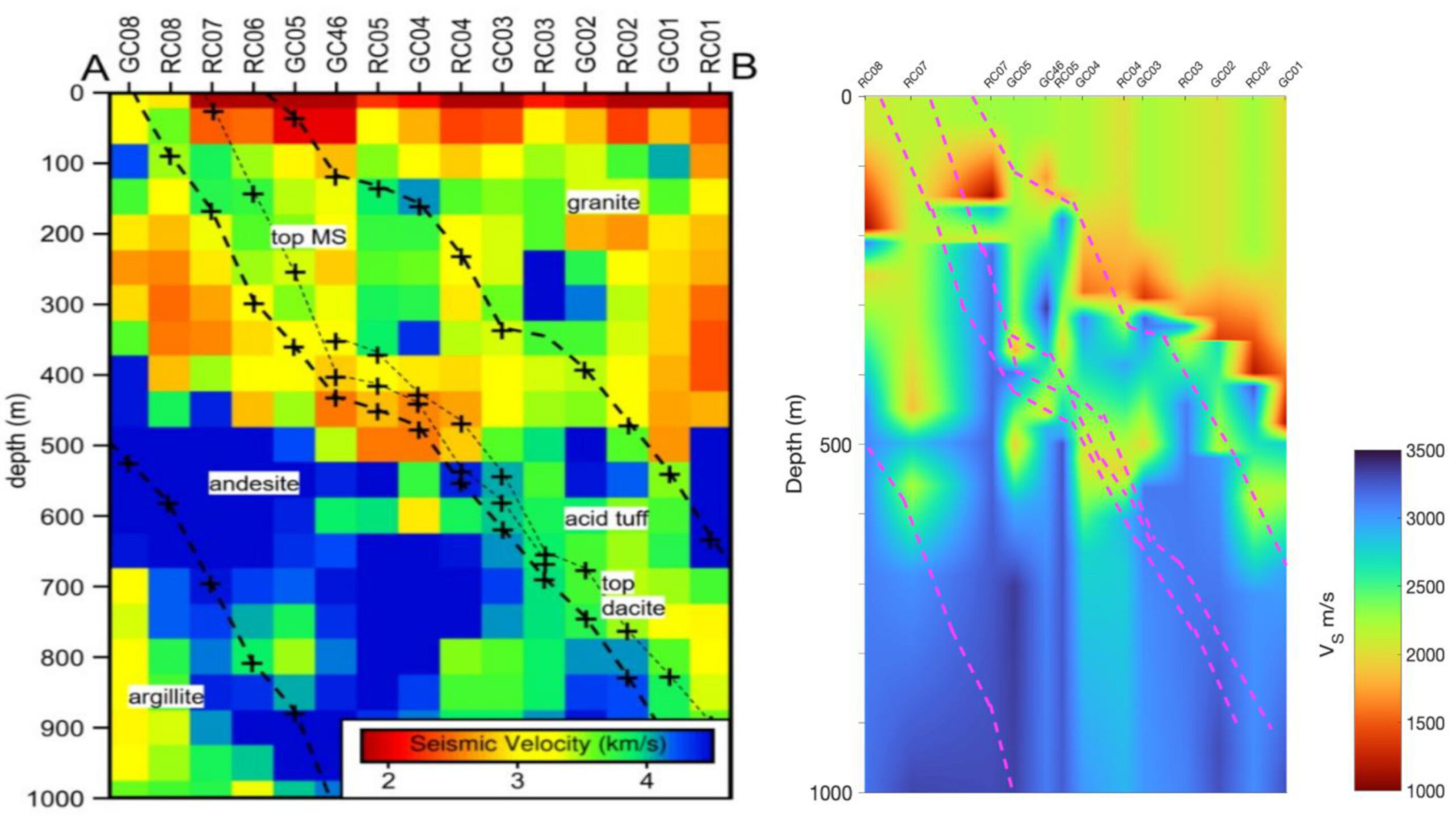
Result description
Within the AGEMERA project, LITH/CSIC succesfully deployed more than one hundred stations at Mina Concepción test site for testing innovative single-station passive seismic methods in a shallow and structurally challenging mineral exploration environment. The methods included: RWE (Rayleigh Wave Ellipticity), AC (Auto Correlations) and HVSR (Horizontal to Vertical Spectral Ratio).
The RWE showed the most promising results being able to image the main lithological/geophysical units. AC was able to detect the main reflectors but a denser seismic network would be required to confirm and consolidate these results.
Addressing target audiences and expressing needs
- Help in technical expertise
- Collaboration
The methods and algoritms would benefit from optimization and automatization which would require high-standard programming experise. Collaborations with other istitution/researchers would be highly beneficial for the future development and upscaling of the technical services we could offer.
- Research and Technology Organisations
- Academia/ Universities
R&D, Technology and Innovation aspects
RWE, AC and HVSR passive seismic methods have been originally developed for other scopes than mining. We are currently testing the effectiveness of these methods for shallow and deep critical raw materials exploration to help achieve EU goals of becoming the first carbon-neutral economy. We are seeking opportunities to build more case studies to prove their full potential.
Contrary to controlled-source seismic methods, passive seismic methods can be easily deployed in nearly all types of terrains with minimal impact for the environment and the society. As for any other geophysical method, the effectiveness of passive seismic methods depends on property constrats between lithological units (i.e. velocity and density). These methods are very versatile and can be applied in diverse settings, but it is mandatory to carefully evaluate each case study and scope of work beforehand to optimize the survey design thus guaranteeing sensible results.
Single-station passive seismic methods demonstrated to be effective in shallow mining exploration. Together with other conventional and innovative geophysical and geological data, they represent a tool capable to predict subsurface geology away from drilled boreholes thus reducing exploration risks and costs. These methods represent a valid and cost-effective alternative to more conventional controlled-source methods. Beside their reduced costs, they are also very low impact thus helping exploration companies to obtain the social licence to explore and operate.
- Europe
Result submitted to Horizon Results Platform by AGENCIA ESTATAL CONSEJO SUPERIOR DE INVESTIGACIONES CIENTIFICAS