
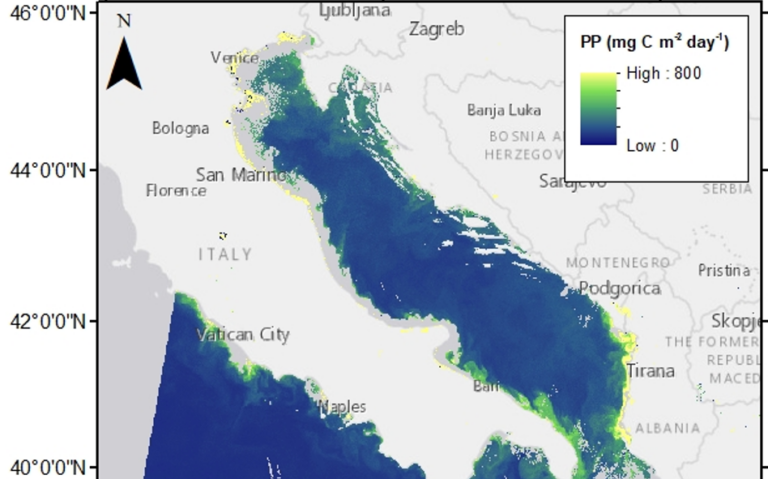
Result description
The CoastObs primary productivity product represents the amount of carbon (or organic material) fixed per area over time by phytoplankton in coastal waters, which is of particular interest to end-users such as environmental managers and aquaculture producers.
What is the problem
Approximately 50% of global net primary production (PP) is attributed to ocean phytoplankton. Phytoplankton PP removes carbon from the surface ocean, playing a major role in regional and global carbon cycling, food web dynamics, biogeochemical cycles and marine fisheries. Earth observation (EO) provides a useful tool for monitoring PP in coastal waters, however most existing satellite derived models have been developed and validated using data from open oceans.
CoastObs solutions
The launch of the Sentinel satellites has opened up new opportunities for monitoring of coastal ecosystems. EO provides the opportunity to monitor the frequent changes in phytoplankton abundance in coastal waters, using the photosynthetic pigment chlorophyll-a (Chl-a) as a proxy. The CoastObs PP model is a depth-integrated model that derives PP as a function of daily phytoplankton carbon fixation within the euphotic zone per unit of water surface area (mg C/m2/day). The model is parameterised using satellite-derived Chl-a, euphotic depth, sea surface temperature and daily photosynthetically available radiation (PAR).
Addressing target audiences and expressing needs
- Grants and Subsidies
- Loans
- Expanding to more markets /finding new customers
Phytoplankton plays a fundamental role in the marine food web, biogeochemical cycling and climatic processes. Estimating its spatiotemporal variations helps us understand biodiversity trends of other marine organisms and surface marine productivity, useful for ecosystem management, fisheries and aquaculture.
- Public or private funding institutions
- EU and Member State Policy-makers
- Other Actors who can help us fulfil our market potential
R&D, Technology and Innovation aspects
Selected Earth Observation based PP models have been tested and regionally tuned, with further validation ongoing.
The services can be rolled out to other areas
Methods are well documented
Earth Observation is a sustainable way of monitoring
- Europe
Result submitted to Horizon Results Platform by CONSIGLIO NAZIONALE DELLE RICERCHE
