
Result description
In SALBAGE project, ICTP-CSIC has proved that it is possible to prepare Polymer Gel Electrolytes (PGEs), with enough conductivity as to be used as electrolytes in batteries, from Deep Eutectic Solvents (DES) and a variety of cheap polymers, in a simple and reproducible way. Moreover, their properties such as conductivity and electrochemical performance can be tuned. This opens the door to shapeable and safe batteries with tailored performance, depending on the combination of materials.
Polymer Gel Electrolytes for Al-based batteries have been prepared and tested in relevant conditions. The PGEs do keep enough conductivity to maintain the electrochemical activity towards Aluminium stripping and deposition.
These PGEs, prepared from affordable materials, are also safe, since they are made out of non-toxic and non-explosive or flammable materials, therefore decreasing the chance of safety issues very common in Li-based batteries.
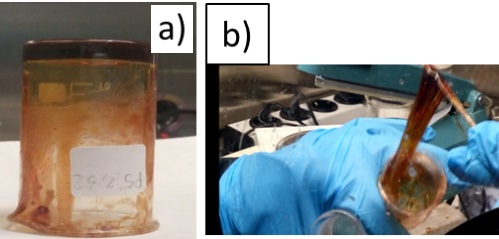
They do not flow (as can be observed in Fig(a)) whereas they present elastomeric (Fig(b)) and thermoplastic properties, being easy to process and to shape. They present self-healing properties (they stick back together if torn or broken).
The preparation is simple and in one-step and does not require auxiliary solvents, what is interesting in order to make it straightforward to scale-up to industry.
Addressing target audiences and expressing needs
- Business partners – SMEs, Entrepreneurs, Large Corporations
Industry interested in using such electrolytes in potential energy-related applications, namely Batteries.
- Public or private funding institutions
- EU and Member State Policy-makers
- Other Actors who can help us fulfil our market potential
- Research and Technology Organisations
- Academia/ Universities
R&D, Technology and Innovation aspects
The use of such polymer gel electrolytes has proved its use and electrochemical performance at lab-scale for the stripping/electrodeposition of Al-based batteries.
Result submitted to Horizon Results Platform by AGENCIA ESTATAL CONSEJO SUPERIOR DEINVESTIGACIONES CIENTIFICAS