Result description
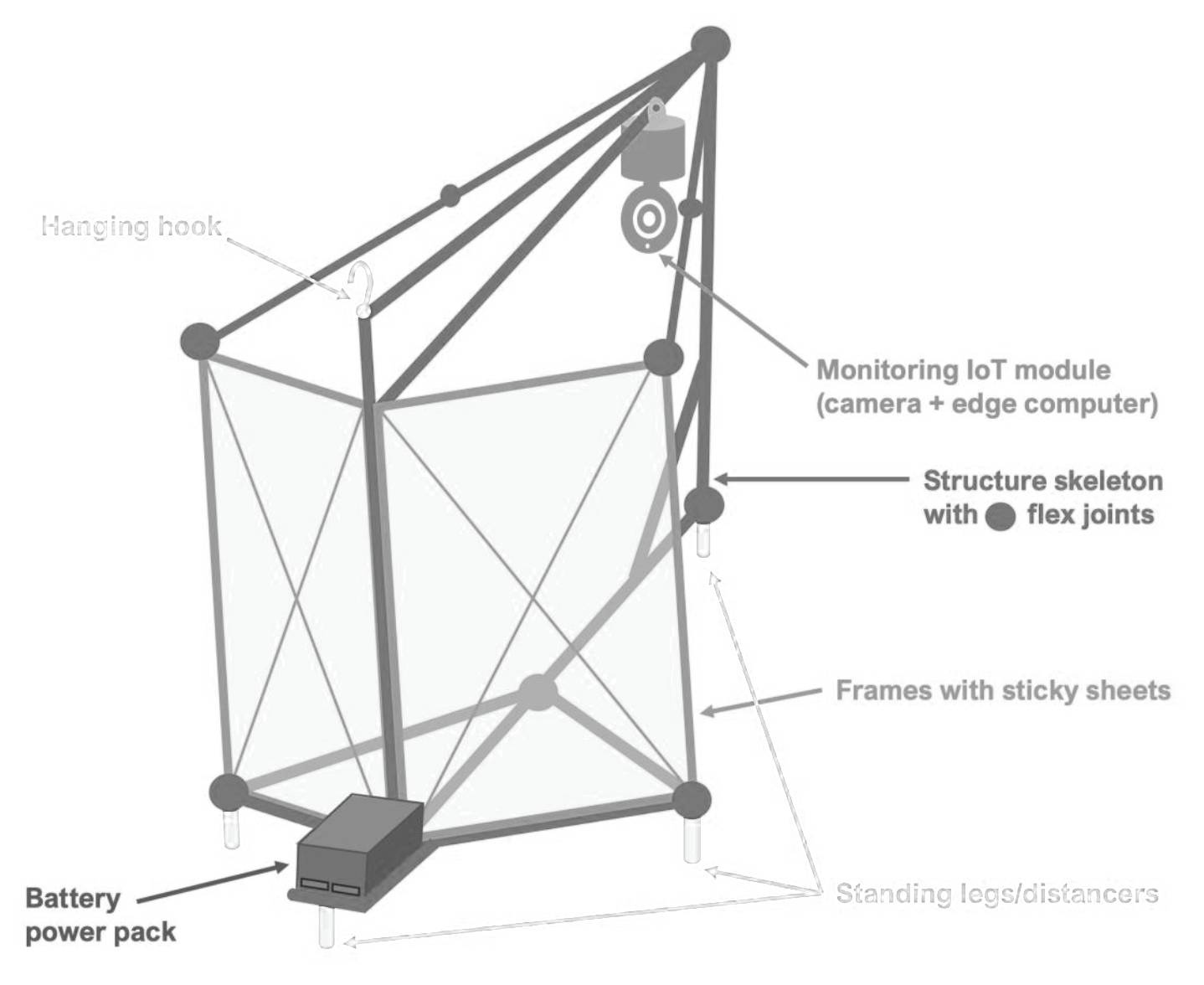
Pheromone trap for sandflies with sticky sheets, camera, Edge AI module, and 4G/5G connectivity for real-time monitoring of sandflies. Modular trap integrates two papers of sticky sheets and uses camera to capture and process insect images directly in the field.
The Semiochemical Sand Fly Monitoring Trap represents an innovative, field-ready solution for automated vector surveillance. Designed through close collaboration with entomologists and field researchers, the trap combines semiochemical lures with advanced IoT and AI technologies to monitor sand fly populations in real time.
Each modular trap integrates A3-sized sticky sheets, a camera, a Raspberry Pi–based edge computer, and 4G connectivity to autonomously capture and transmit images of trapped sand flies every two hours. The system’s AI model automatically detects and counts sand flies on the adhesive surfaces, providing instant data through a secure web interface for continuous monitoring.
The lightweight, foldable mechanical design ensures cost-effective deployment and maintenance in diverse field environments, while battery-powered autonomy supports long-term operation without infrastructure dependence.
Addressing target audiences and expressing needs
- We are sharing our knowledge
- Others/ No specific audience
- Research and Technology Organisations
- Academia/ Universities
R&D, Technology and Innovation aspects
Validated in CLIMOS field campaigns in Spain, Italy, Portugal, and Slovenia, the system has demonstrated its effectiveness for scalable, real-time sand fly surveillance. It enables researchers and health authorities to better understand vector population dynamics, improve early warning systems, and support evidence-based interventions to mitigate the spread of sand fly–borne diseases.
The system can be replicated with minimal dependency on proprietary components or specialized manufacturing. Its structure is based on standard aluminum profiles and polycarbonate panels, which can be sourced and assembled locally using basic tools. The electronic setup—comprising a Raspberry Pi, a camera, and a 4G modem—relies on open hardware and software, allowing straightforward configuration and adaptation. Field tests in Spain, Italy, Portugal, and Slovenia have shown that the traps perform consistently across varying climates and operational settings, confirming robustness and reproducibility.
Result submitted to Horizon Results Platform by PRIVREDNO DRUSTVO ZENTRIX LAB DRUSTVO SA OGRANICENOM ODGOVORNOSCU PANCEVO