Result description
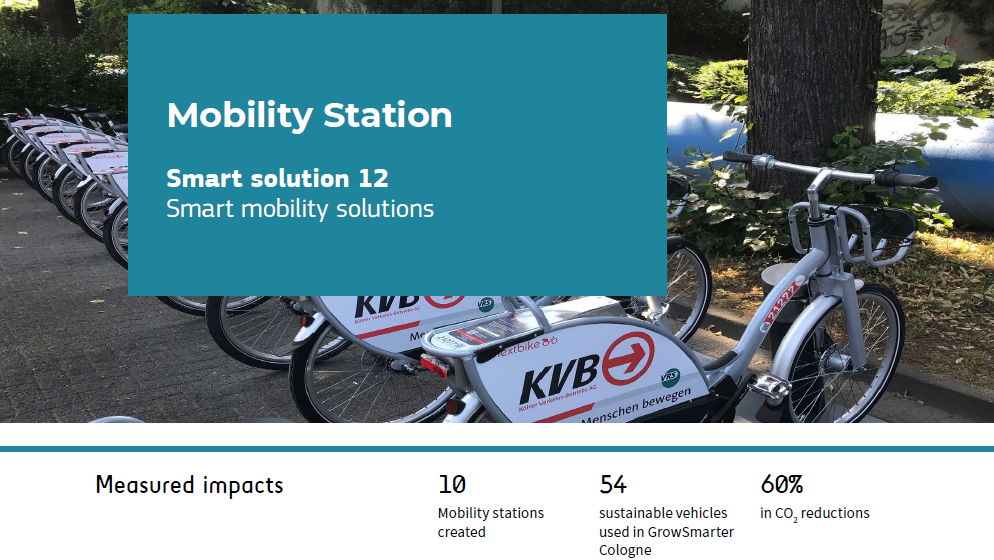
A mobility station offers multiple transport alternatives at one location. The mobility stations can vary in both size and type of location, and the transportation alternatives can include public transport, electric car-sharing, conventional car-sharing, timesharing of private and public parking spaces, as well as conventional bike-sharing and e-bike-sharing. This solution is designed to improve air quality and lower traffic and carbon emissions by making the transition to more energy/emission-efficient transport alternatives easier.
Ten mobility stations were implemented in Cologne. The key steps taken to establish mobility stations include identification of possible locations (including analysis of customer needs), securing permits, preparing parking spaces and installing equipment, and preparing customer interfaces such as ticketing systems and signage. The mobility station signage developed by Cologne has become the standard used in the Federal State of North-Rheine Westphalia.
The city wanted to encourage behavioural change away from cars towards more active modes of transport like walking, cycling and public transport.
Lessons learnt
It is important to understand who owns the land on which mobility stations are located and to ensure that locations are visible sites that match user needs or preferences (i.e. easily accessible). There may be restrictions on use of public land for private ventures (leading to prohibitions, additional costs or fees, or need for exemptions from laws). The dynamic nature of the market for mobility solutions means new private mobility operators are emerging, adding to the complexity of developing business models for service providers but offering potential to integrate additional services into or close by mobility stations (e.g. cargo bikes, scooters, delivery boxes, more).
Upscaling & replication potential
Many cities are introducing mobility stations as part of their work with Sustainable Urban Mobility Plans. Cologne has developed a master plan for mobility stations within the city limits. The city’s experiences highlight a range of tasks and challenges that other cities can learn from to replicate the concept
Addressing target audiences and expressing needs
- We are sharing our knowledge
- Others/ No specific audience
- EU and Member State Policy-makers
R&D, Technology and Innovation aspects
Result submitted to Horizon Results Platform by AMPIDO GMBH