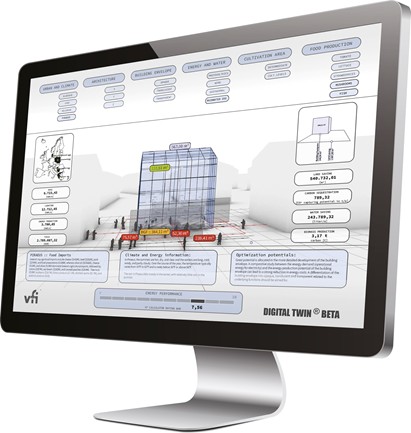

Result description
The Digital Twin for Indoor Farming Simulation is a parametric modelling environment developed by VFI to support early-stage decision-making for indoor vertical farms. Using simplified 3D geometry, it generates energy estimates for different farming layouts and system configurations and can retrieve additional calculations for site energy potentials (e.g., solar and wind) when urban context is included. The tool enables architects, developers, planners and researchers to test design options quickly and compare them against key performance indicators (KPIs) such as energy demand, expected yield-related performance and resource efficiency. By providing a fast, cost-efficient way to screen concepts, it supports stop/go criteria for subsequent feasibility studies, investment decisions and detailed design. The solution is currently at TRL 5-6 and can be exploited via consultancy-based feasibility studies and online access, with IP/patent consultation ongoing.
Addressing target audiences and expressing needs
- Business partners – SMEs, Entrepreneurs, Large Corporations
- Technology Transfer Expertise
- Executive Training
Partners (architects, developers, planners) to provide real indoor-farm projects or concepts for validation and calibration of energy/yield KPIs. Engineering and research partners to benchmark the model against measurements and extend modules (lighting, HVAC, fertigation, crop yield). Municipalities/building owners to pilot urban-context integration (rooftops, wind/solar exposure). Funding/investors to mature the tool, UX, and online delivery, and to support IP/patent work.
- Public or private funding institutions
- Other Actors who can help us fulfil our market potential
- Private Investors
R&D, Technology and Innovation aspects
TRL 5–6: validated parametric simulation environment for early-stage indoor-farm layout and energy estimates, with optional urban-context integration (solar/wind potential). Next steps: improve accuracy through calibration with real projects, expand modules (HVAC/lighting/yield KPIs), strengthen UX and online delivery, and progress IP/patent strategy. We seek funding and pilot partners.
Yes. As a software-based simulation framework, it can scale via online access and repeatable consultancy workflows. Modular components (layout, energy demand, context-based solar/wind, KPI reporting) can be extended without redesigning the core model. Once validated and packaged, it can support many projects with low marginal cost per additional study.
Yes. The tool supports sustainability by enabling evidence-based design choices that reduce energy use, improve resource efficiency and accelerate viable low-impact indoor farming projects. Value is delivered through fast, repeatable early-stage screening (layout + energy potential + KPI checks) that saves time and prevents misinvestment in unfeasible concepts. Economic value can be captured through feasibility-study consultancy contracts, paid online use/subscriptions, and a fee-based planning/business-model support service. As validation and modules mature, delivery becomes more standardised and efficient, improving unit economics while maintaining quality. IP protection (under assessment) can further support long-term competitiveness.