

Disclaimer: This article is an original summary of information published via PR Newswire and is provided for informational purposes only. This article describes the results of a scientific article published in the journal “Small” under doi.org/10.1002/smll.202507626.
Researchers from Chonnam National University (South Korea) have developed a novel approach that significantly improves the performance of tin monosulfide (SnS) thin-film solar cells, a technology long considered promising but technically constrained. The breakthrough addresses a critical efficiency bottleneck that has limited the commercial viability of this environmentally friendly photovoltaic material for years.
Solving a Persistent Materials Challenge
SnS is attractive as a solar absorber because it is abundant, non-toxic, and well-suited for thin-film applications. However, its efficiency has historically been hindered by poor electrical contact at the interface between the metal back electrode and the absorber layer, leading to charge recombination and energy loss.
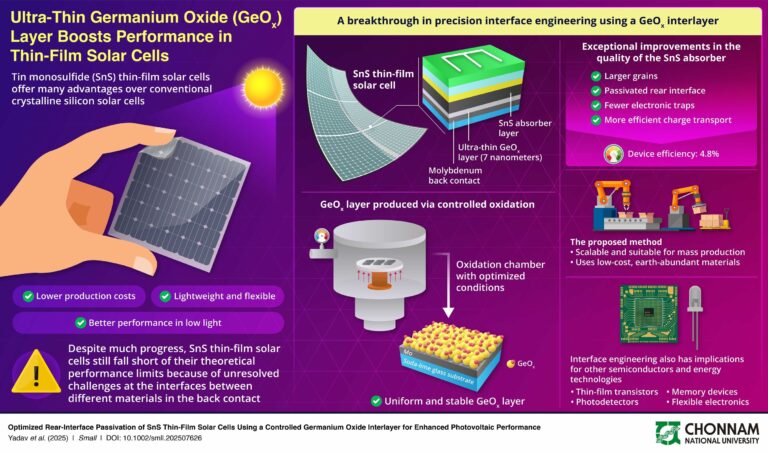
To overcome this issue, the research team introduced an ultra-thin germanium oxide (GeOₓ) interlayer, measuring just a few nanometres thick, between the molybdenum back contact and the SnS absorber. This interlayer acts as a passivation and energy-level alignment layer, reducing defects and improving charge transport across the interface.
Significant Efficiency and Stability Gains
By incorporating the GeOₓ interlayer, the researchers achieved an efficiency improvement of nearly 30% compared to conventional SnS thin-film solar cells. Beyond efficiency gains, the modified cells also demonstrated enhanced operational stability, addressing another key challenge for thin-film photovoltaic technologies.
The results show that even minimal material modifications at critical interfaces can lead to substantial performance improvements, without requiring complex or costly fabrication processes.
Implications for Sustainable Solar Technologies
This advancement is particularly important for the future of sustainable and scalable solar energy systems. Unlike many high-efficiency solar technologies that rely on rare or toxic elements, the materials used in this approach remain compatible with low-cost, environmentally responsible manufacturing.
The findings open new pathways for improving not only SnS-based devices but also other thin-film solar technologies where interface losses limit performance.